Stop using stainless fasteners on your Land Rover!
tl;dr: “Stainless makes corrosion worse and is brittle”
Reason #1 - Galvanic Corrosion
Wikipedia explains why it's a bad idea, I put this page here basically just to try and help any passers-by. Northern Precision have a good explainer and a better chart too. Ay oop.
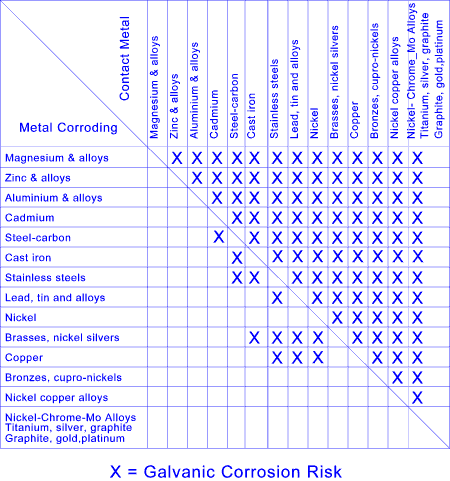
Stainless pipe onto aluminium casting equals…
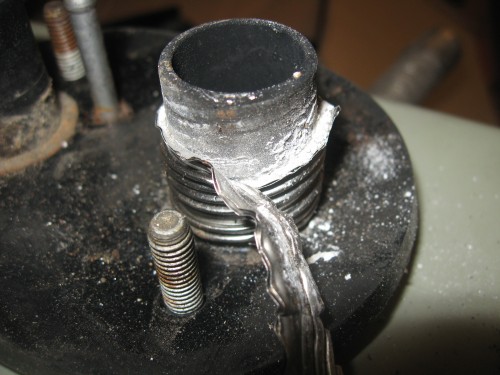
Chart stolen from Northern Precision's website:
| LEAST NOBLE - ANODIC / ACTIVE (MOST LIKELY TO CORRODE) |
|---|
| Material |
| Magnesium |
| Magnesium Alloys |
| Zinc |
| Beryllium |
| Aluminium 1100, 3003, 3004, 5052, 6053 |
| Cadmium Aluminium 2017, 2024, 2117 |
| Mild Steel 1018, |
| Wrought Iron |
| HSLA Steel, Cast Iron |
| Chrome Iron (active) |
| 430 Stainless (active) |
| 302, 303, 321, 347, 410, 416 Stainless Steel (active) |
| Ni-Resist 316, 317 |
| Stainless (active) |
| Carpenter 20Cb-3 Stainless (active) |
| Aluminium Bronze (CA687) |
| Hastelloy C (active) |
| Inconel 625 (active) |
| Titanium (active) |
| Lead/Tin Solder |
| Lead Tin |
| Inconel 600 (active) |
| Nickel (active) |
| 60% Ni 15% Cr (active) |
| 80% Ni 20% Cr (active) |
| Hastelloy B (active) |
| Naval Brass (CA464), Yellow Brass (CA268) |
| Red Brass (CA230), Admiralty Brass (CA443) |
| Copper (CA102) |
| Manganese Bronze (CA675), Tin Bronze (CA903, 905) |
| 410, 416 Stainless (passive) |
| Phosphor Bronze (CA521, 524) |
| Silicon Bronze (CA651, 655) |
| Nickel Silver (CA 732, 735, 745, 752, 754, 757, 765, 770, 794 |
| Cupro Nickel 90-10 |
| Cupro Nickel 80-20 |
| 430 Stainless (passive) |
| Cupro Nickel 70-30 |
| Nickel Aluminium Bronze (CA630, 632) |
| Monel 400, K500 |
| Silver Solder Nickel (passive) |
| 60% Ni 15% Cr (passive) |
| Inconel 600 (passive) |
| 80% Ni 20% Cr (passive) |
| Chrome Iron (passive) |
| 302, 303, 304, 321, 347 Stainless (passive) |
| 316, 317 Stainless (passive) |
| Carpenter 20Cb-3 |
| Stainless (passive), Incoloy 825 (passive) |
| Silver |
| Titanium (passive), Hastelloy C & C276 (passive) |
| Graphite |
| Zirconium |
| Gold |
| Platinum |
| MOST NOBLE - CATHODIC / PASSIVE (LEAST LIKELY TO CORRODE) |
Reason #2 - Hardness is not Toughness
Stainless fasteners are very hard but they are very brittle, so they will snap under loads rather than stretch or bend. It is positively dangerous to use them for towing attachments, recovery points, wheel studs, brake callipers, steering, suspension… basically anywhere the manufacturer of your vehicle used a high-strength steel fastener.
Reason #3 - Galling
Stainless fasteners are way more prone to galling - binding up and self-welding - and when that happens you've now got an incredibly hard thing stuck somewhere. It's harder to drill a stainless fastener out, and if it's into a softer parent metal your drill bit is going to want to wander to the soft stuff.


